

Sometimes Phoenix Doesn't Rise from the Ashes
Layoffs are risky. The story of the Phoenix project shows what can go wrong and offers useful lessons for leaders pursuing large scale transformation.


In mythology, the phoenix is a bird that is consumed by fire and then reborn. It is an image of renewal after destruction, a symbol of transformation, resilience, and new life.
When companies restructure and downsize, leaders often assume that after the deed is done, a stronger, more effective organization will rise from the ashes.
But in organizational life, you don’t get renewal simply by cutting heads. If you cut too deeply, move too quickly, or fail to understand the intricacies of the work, what rises from the ashes may not be a stronger organization, but one that is severely damaged.
That is what happened when the Canadian government decided to transform how it paid federal employees . And yes, Phoenix was the actual name of the project.
Its objective was to replace an aging payroll system and create a more efficient, centralized model for paying public servants. But instead it became a case study for what can happen when leaders underestimate the complexity of work, reduce capacity too quickly, and assume a new model will perform as expected.
The core lesson of Project Phoenix is simple: when you cut people, you are not just cutting cost - you may also be cutting capacity, knowledge, judgment, process memory, customer understanding, and the informal workarounds that keep the system running.
The promise of Phoenix
The “Transformation of Pay Administration Initiative” was approved in 2009 to solve a real problem: The Canadian government’s pay system was 40 years old, costly, fragmented, and difficult to maintain. Pay administration was spread across departments and agencies. The compensation environment was extraordinarily complex: close to 8.9 million annual transactions, approximately $17 billion in pay, 22 different employers, more than 80 collective agreements, and over 80,000 business rules.
The solution had two elements: Replace the old pay system with a commercial off-the-shelf solution and create a central hub to run it.
On paper, the plan was compelling. Modern technology plus centralized service delivery would allow the government to do the work with fewer people. Prior to 2012, there were 2,000 pay advisors spread out across countless locations. Centralizing payroll was expected to eliminate 650 positions and save $78 million per year - a pretty good return on a $310 million investment.
But it did not go according to plan.
The system went live in 2016. The first phase of the rollout system covered 34 departments and 120,000 employees. It was bumpy. Thousands of public servants filed complaints about underpayments. Despite those early warnings, the government pressed ahead and expanded the scope to the remaining 67 departments.
And then the wheels came off.
The number of outstanding pay requests exploded.
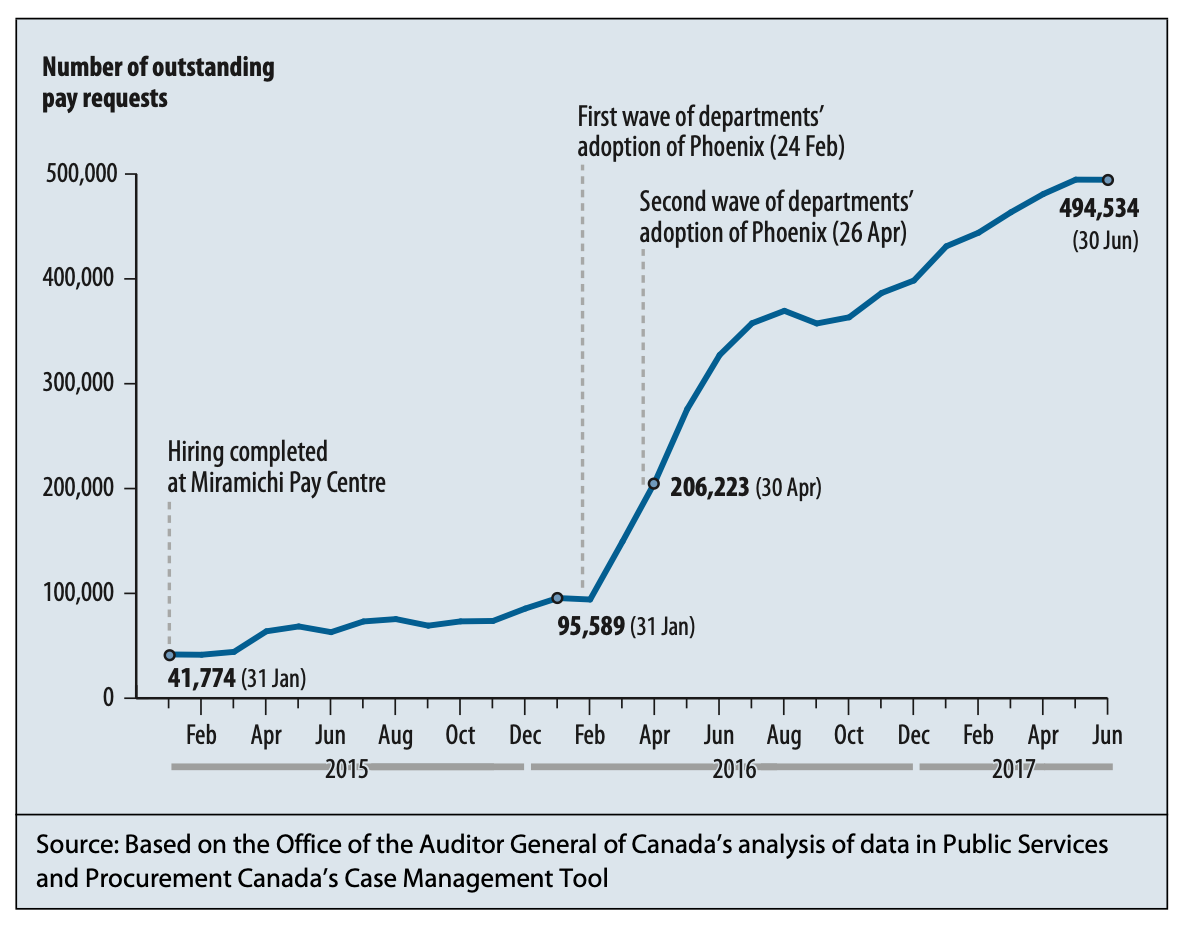
By 2018, 80% of the workforce had been either overpaid, underpaid, or not paid at all. The public outrage and the growing backlog forced the government had to reverse course and bring back many of those that had been laid off.
By 2026, the number of employees at the central payroll centre had quadrupled, with 60% of them dedicated to working on the backlog.
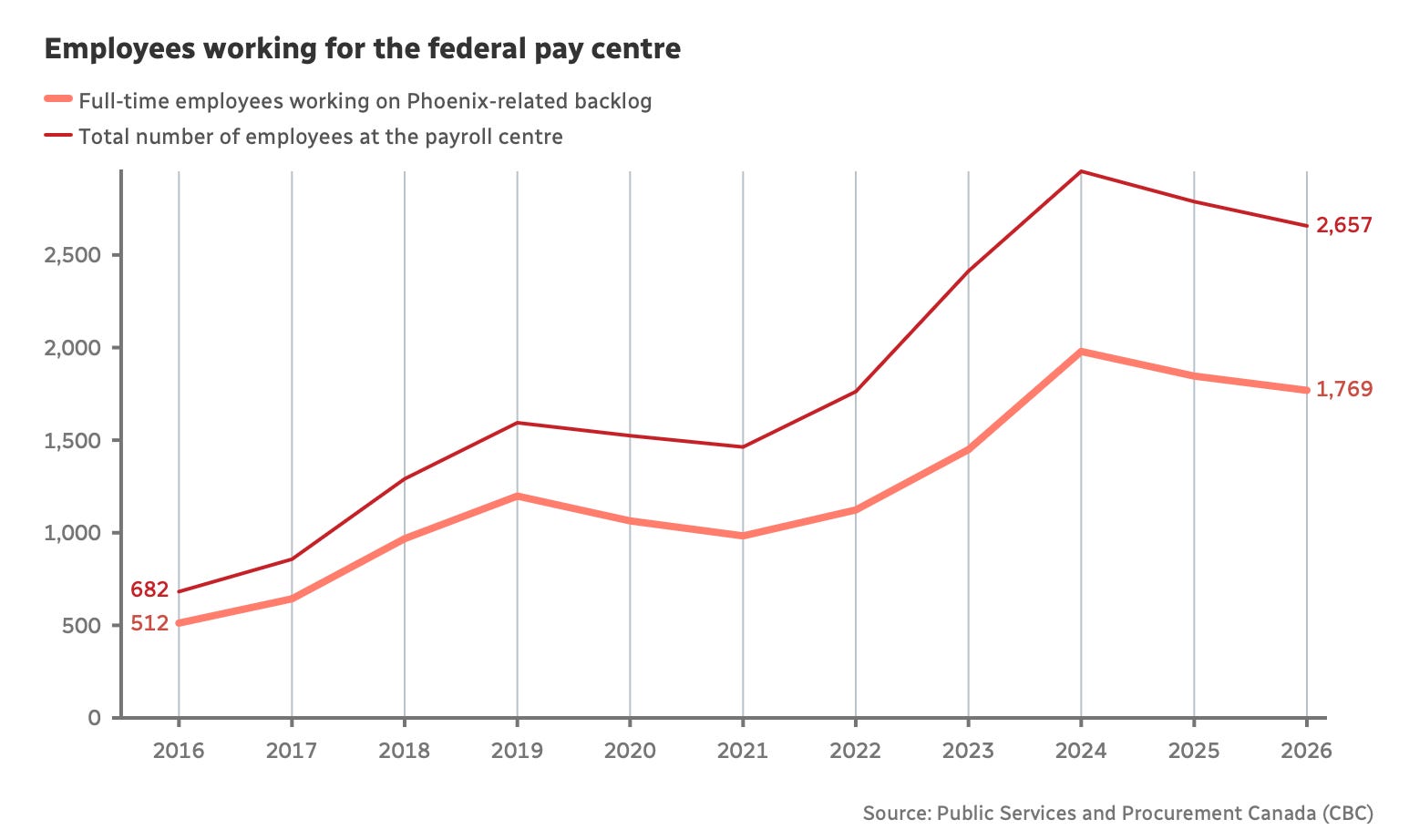
Ten years into it, the total cost for the taxpayer is estimated to be $5 billion.
Ouch.
The project has become a national embarrassment. It also triggered numerous studies and audits to understand what went wrong. And if you are a leader about to undertake a large scale restructuring, understanding these mistakes can help you avoid making the same ones.
Mistake #1: Underestimating the complexity of work
Phoenix was treated largely as two separate projects: technology modernization and centralization. But the real transformation touched far more than technology and location. It changed business processes, roles, responsibilities, systems, training, communications, governance, and the knowledge base required.
That distinction matters.
Many layoffs fail for the same reason. Leaders define the change too narrowly. They think in terms of roles eliminated, cost removed, and boxes changed on an org chart. But the organization experiences the change as a full operating model disruption.
The work still has to move. Decisions still have to be made. Customers still need answers. Reports still need to go out. Systems still need to be maintained. Exceptions still need to be handled. And all the hidden knowledge that used to live in people’s heads suddenly matters more than anyone expected.
Phoenix shows what happens when leaders do not fully map the work before changing the model. One audit noted that few people outside the compensation advisor community understood the day-to-day complexity required to ensure accurate pay. Some reportedly viewed the modernization as essentially “replacing a giant calculator.” That framing dramatically underestimated the expertise of compensation advisors and the complexity of the work they performed.
Mistake #2: Cutting expertise too soon
The project was expected to generate savings in the first year of go-live. A large portion of those savings depended on eliminating 700 positions. The layoff happened before the new system had stabilized and before the new operating model had proven it could carry the load.
The result was predictable in hindsight. Many experienced compensation advisors left before go-live, taking critical knowledge with them. Newly hired employees at the center did not yet have the depth of experience required. The report notes that learning federal compensation can take years because of the complexity of collective agreements, rules, exceptions, and systems. There were also no formal mechanisms established to transfer knowledge before eliminating positions.
That is the post-layoff trap.
A spreadsheet may show that a function can operate with fewer people. But unless leaders know exactly what knowledge is being removed, what capacity remains, and how long it will take new people or new systems to become productive, the savings are often short-lived.
Mistake #3: Assuming savings materialize immediately
One of the most important lessons from the Phoenix report is that leaders should not expect savings until well after implementation. The original plan assumed savings starting in the first year of Phoenix go-live. That assumption required the new system, new Pay Centre employees, managers, HR professionals, and employees to all be productive immediately.
That was unrealistic.
The more realistic scenario, according to the report, would have been increased costs in the first year: keeping some experienced compensation advisors in place, supporting managers and employees through the transition, and allowing the central team to ramp up gradually. Savings would then come over time as the new model stabilized.
This is a critical lesson for leaders conducting layoffs. The question is not simply, “How soon can we take out the cost?” It is, “What bridge capacity do we need until the new model actually works?”
Mistake #4: Relying on one way, top down communication
Phoenix also illustrates another common mistake: confusing communication activity with communication effectiveness.
The studies found that communications were often one-way, top-down, delayed, incomplete, or lacking context. Departments received instructions, but not always enough explanation to know what action was required or why it mattered. For example, departments were told to clean HR data, but some cleaned the wrong data or did not clean it in the way the system needed.
After a RIF, leaders often believe they have communicated because they have held a town hall, sent an email, or shared an FAQ. But that communication rarely provides the clarity to act.
After a layoff, the team needs to know:
What work is still required?
What work is stopping?
Who owns what now?
Which decisions are temporary?
Where should risks be escalated?
What support is available?
What happens next?
If those questions are not answered, people fill the vacuum themselves. They guess. They protect themselves. They duplicate work. They avoid decisions. Or they leave.
Mistake #5: Skipping the pressure test
Phoenix also went live before the model was ready. The report states that the system was not fully tested through end-to-end real-life simulations with a broad spectrum of real users. Although thousands of test scripts were executed, the testing did not adequately expose the likely challenges created by complex workarounds, imperfect HR data, late information, and multiple pay issues for individual employees. A planned pilot was cancelled because testing was not complete.
For corporate leaders, the equivalent is announcing a new structure without testing whether the work can actually flow through it. Before declaring a post-layoff model ready, leaders need to pressure-test it:
Can the remaining team handle the volume?
Do people understand their new responsibilities?
Have critical handoffs been redesigned?
Are decision rights clear?
Are customers and stakeholders aligned to new service expectations?
Is there contingency capacity if the model breaks?
A new org chart is not an operating model. It is only a hypothesis.
Mistake #6: Ignoring bad news
The independent report describes an environment where bad news was minimized, risks were not always escalated, and confidence in the project was reinforced even when serious concerns existed.
This may be the most important leadership lesson of all.
Complex transformation requires a culture that is agile, open to change, responsive to stakeholder feedback, and willing to receive unwelcome information.
After a layoff, the truth gets harder to hear. People are afraid. Managers want to look capable. Executives want reassurance that the savings plan is working.
That is exactly when leaders need to ask:
What is breaking?
Where are we relying on heroics?
Who is overloaded?
What is the impact on the customer?
What are people afraid to tell us?
If leaders do not create channels for bad news, they will not see the problems until later, when they are more expensive to fix.
Hope is not a strategy
The mythological phoenix rises from the ashes. But organizations do not automatically renew themselves after destruction. Renewal has to be designed.
For leaders managing a layoff, the Phoenix project offers some important lessons:
Do not assume the work disappears because the roles do.
Do not let the best people quietly absorb the burden.
Do not cut institutional knowledge before you have captured it.
Do not expect technology to save a process that has not been simplified.
Do not declare the new model ready until it has been tested.
And above all, do not treat the period after a layoff as business as usual.
A RIF creates a rare but narrow window to rethink the work. Leaders can use that window to reduce unnecessary activity, simplify processes, apply technology intelligently, create motivating jobs, and rebuild trust. Or they can use it merely to cut cost and hope the organization adapts.
The main takeaway from the Phoenix fiasco is clear: hope is not a strategy.
A reduction in force may lower costs, but it also creates new risks: overloaded teams, lost knowledge, unclear ownership, and declining performance.
Our After the RIF playbook gives leaders a practical 90-day roadmap to stabilize the team, right-size the work, protect critical talent, and rebuild performance.
If your organization is navigating a layoff, restructuring, or post-RIF recovery, we offer a complimentary 30-minute Recovery Diagnostic to help you identify the most important actions to take next.
What gets me isn’t the $5 billion. It’s the org chart being treated as the operating model. Leadership announced the new structure and assumed the work would just flow through it. Real alignment isn’t an announcement, it’s a test: can the actual work move through what you’ve redesigned, or just the boxes on the slide? Most restructuring fails quietly in that gap, long before anyone admits it out loud.